Neon bills Postgres by the CU-hour with scale-to-zero. Here is the 2026 rate card, the always-on trap that 5x-es your bill, three worked 30-day bills, and the crossover versus a fixed instance.
Render's advertised prices hide the real bill. In 2026 your cost is three stacked layers: a workspace plan, per-service compute, and metered usage. A solo production app starts near $13/mo (not $7), a small team app around $115/mo. Here is the arithmetic, with three worked 30-day bills.
Sentry pricing in 2026 is event-based: a free Developer plan, Team at $26/mo and Business at $80/mo (billed annually), each including 50,000 errors, 5M tracing spans, 50 replays and 5 GB of logs. Everything above that baseline is pay-as-you-go, and that overage, not the sticker, is your real bill. Errors run about $0.15 to $1.11 per 1,000 and spans about $1.60 to $4.00 per million, so tracing usually dominates. Below: the full per-unit ladder, three modeled 30-day bills, and why the Business plan includes the same base quotas as Team at three times the price.
Cloudflare R2 pricing in 2026 charges for storage and operations but never for egress: Standard storage is $0.015/GB-month, Class A writes $4.50/million, Class B reads $0.36/million, with a permanent free tier of 10 GB plus 1M/10M operations. Free egress is the whole pitch, and it moves your bill onto operations, not gigabytes. Below: three real 30-day bills versus Amazon S3 and Backblaze B2, and the Infrequent Access trap that doubles a write-heavy bill.
The 2026 Claude API rate card is the floor. Your output-to-input ratio decides the bill. Here it is as a real 30-day bill across three workloads, plus the three levers that cut it.
Firebase pricing in 2026 is free to start (Spark: 50K Firestore reads a day) then pay-as-you-go on Blaze at $0.06 per 100K reads, with no hard spending cap. New in 2026: Firestore now ships in two editions (Standard and Enterprise), SQL Connect adds a fixed floor from about $9.37/month, and App Hosting has its own bandwidth meter. Three real 30-day bills inside.
Clerk's Free plan covers 50,000 monthly retained users (MRU) in 2026, so most side projects and early-stage SaaS pay $0. Pro is $25/month with 50,000 MRU included, then $0.02 per user in the 50,001 to 100,000 band. The bill that surprises teams is not per-user overage; it is the feature add-ons, B2B Auth at $100/month, Administration at $100/month, and extra Enterprise SSO connections at $75/month each. Clerk also bills retained users, not signups, so anyone who does not return 24 hours after signing up costs nothing.
Stripe's US rate in 2026 is 2.9% + $0.30 per online card charge with no monthly fee, but the flat 30-cent fee and five add-on meters (international +1.5%, currency conversion +1%, instant payouts 1.5%, disputes $15, Billing 0.7%) push most businesses to an effective 3.2% to 13%. Your real rate is a function of your average order value and how you get paid.
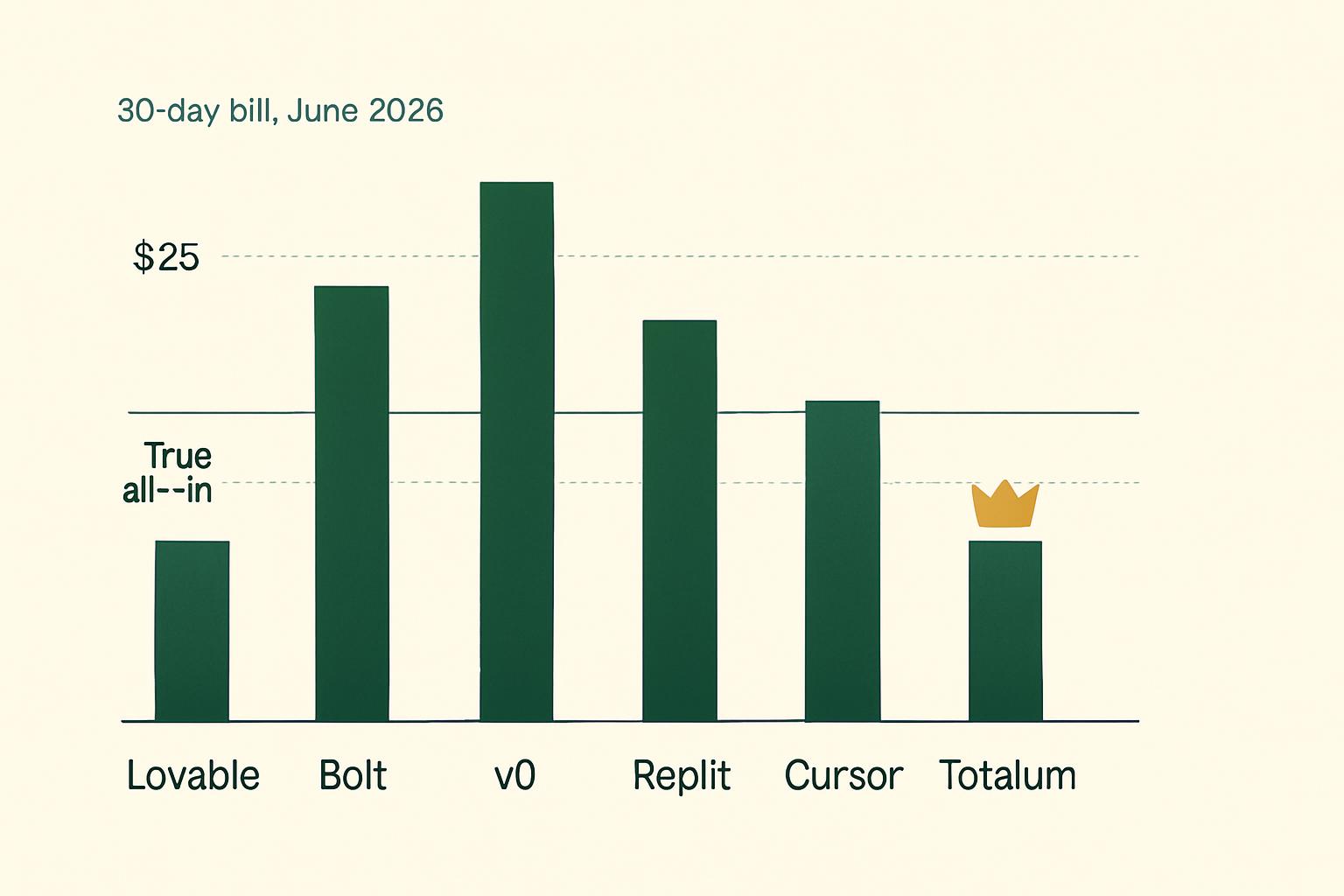
The sticker on Lovable, Bolt, v0, Replit, Cursor, and Totalum is between $20 and $79. The 30-day bill on a real reference workload is $69 to $270. Here is what each pricing page leaves off, with the math.
Three pricing ladders beat flat per-seat pricing for AI products in our teardown of 40 launches: a credit ladder, a usage-with-floor ladder, and an outcome ladder. Each cleared a 7%+ trial-to-paid rate by aligning the price metric with the value metric and putting a visible cap on downside. Pick the ladder that matches how your users feel cost, tokens, runs, or results, and price the rung, not the seat.
Your headline rate is a vanity number. Your effective hourly rate, total income divided by every hour the business consumed, billable or not, is what you actually earn. For most freelancers it lands 35–55% below the rate on their invoice once you count admin, sales, and unbilled rework. This piece shows how to compute it, why it's always lower than you think, and the three moves that raise it without raising your rate.