Tools & Insights

Calculators and money-honest breakdowns for founders who run the numbers.

Featured interactive tool

LLM Token Cost Calculator

Model your own monthly bill across OpenAI, Anthropic, and Google, or price a custom model. No signup.

Open the calculator

Featured interactive tool

Stripe Effective Rate Calculator

See your blended processing rate across a real transaction mix, not just 2.9% + 30¢. Average ticket, international cards, ACH, and more. No signup.

Open the calculator

61 posts

tools

PostHog Pricing in 2026: What You Actually Pay

As of July 2026, PostHog has no fixed subscription. It is free to start with no credit card, and each of its products bills separately once you pass a generous monthly free tier: 1M product-analytics events, 5K session replays, 1M feature-flag requests, 100K error-tracking exceptions, and more. Product analytics starts at $0.00005 per anonymous event and gets cheaper per event as volume rises. The catch nobody flags: identified events can cost up to 4x more. Most side projects pay $0; a growing SaaS usually lands between roughly $50 and a few hundred dollars a month; the five-figure horror stories come from high-volume, autocapture-heavy, all-identified setups with no billing limit set.

8 min read724
tools

Upstash Pricing in 2026: What You Actually Pay for Serverless Redis

As of July 2026, Upstash Redis is free up to 256 MB and 500K commands per month; pay-as-you-go bills $0.20 per 100K commands plus $0.25/GB stored, and fixed plans run $10 to $1,500/month. Because Upstash charges per command, not per server, request volume sets your bill, not data size. Above ~5M commands/month a flat $10 fixed plan usually beats pay-as-you-go.

7 min read318
Infrastructure economics

Fly.io Pricing in 2026: The Real 30-Day Bill

Fly.io pricing in 2026 is pure pay-as-you-go: you pay per second for the Machines (micro-VMs) you actually run, not a fixed plan. A small always-on app on a shared-cpu-1x 256MB Machine costs about $2.02 a month; a two-Machine production SaaS with Postgres and Redis lands near $29 a month; a three-region app on performance Machines runs about $226 a month. The old Hobby, Launch, and Scale plan names were retired in the October 2024 pay-as-you-go switch, and the biggest lever left is a machine reservation, which cuts committed compute by 40%.

10 min read573

Mux Pricing in 2026: What You Actually Pay to Stream Video

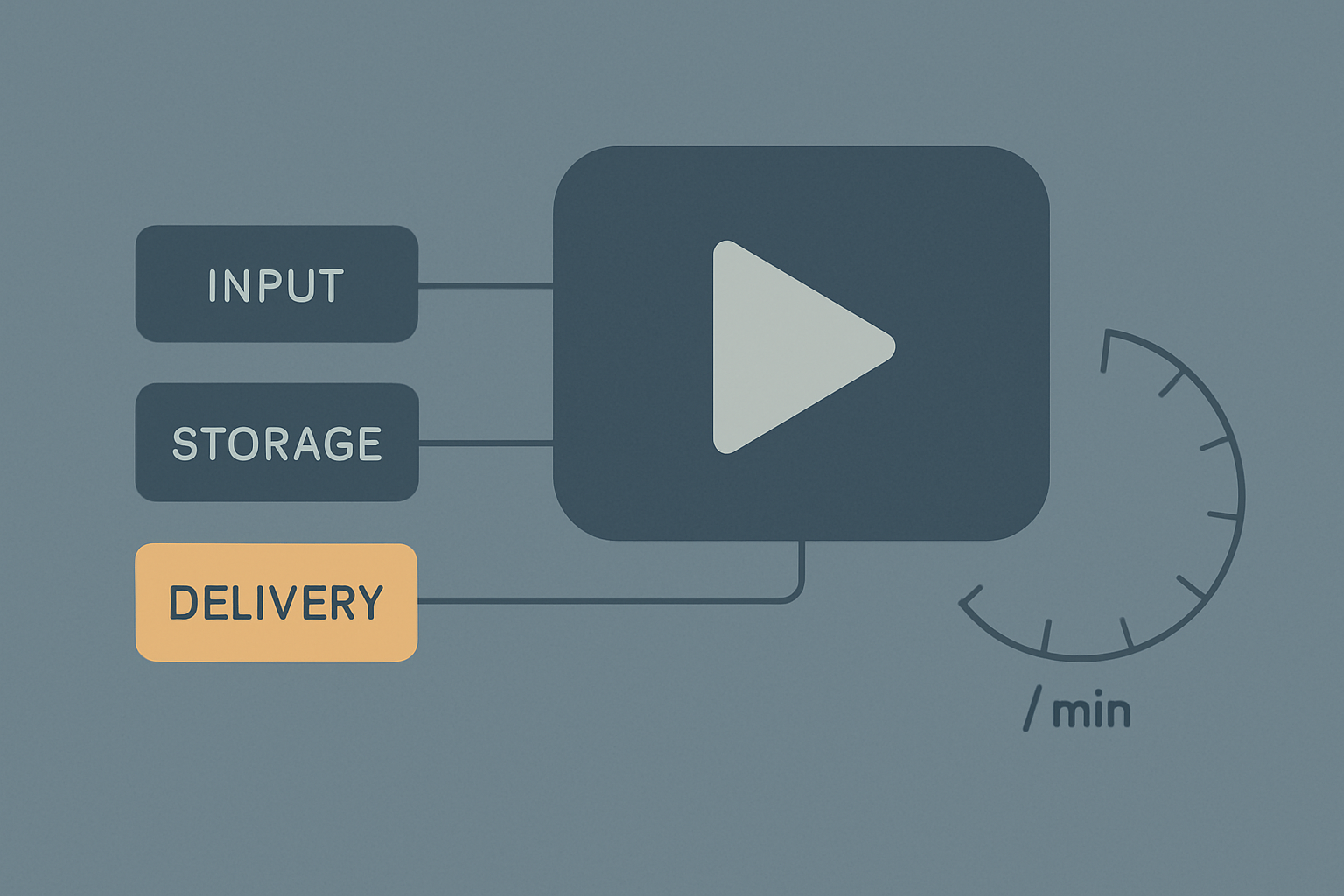
Mux bills video in three meters, not one plan price. Here is the real 2026 arithmetic: worked 30-day bills for three app sizes, the resolution multiplier that quietly quadruples costs, and four levers that lower the bill.

6 min read353

Pinecone Pricing in 2026: What You Actually Pay

Pinecone runs on usage-based serverless pricing in 2026: a free Starter tier, a $20/month flat Builder plan, and a Standard plan with a $50/month minimum. You pay $16 per million read units, $4 per million write units, and $0.33 per GB of storage each month. The catch most teams miss: a query costs one read unit per GB of namespace size, not per query, so your bill is set by how you shape your namespaces, not how many searches you run. A hobby RAG app fits the free tier at $0; a 20 GB single-corpus production app runs about $110/month; a 50-million-vector multi-tenant app with per-tenant namespaces lands near $75.

9 min read317

Algolia Pricing in 2026: What Search Really Costs

As of July 2026, Algolia uses usage-based pricing with no flat subscription on its self-serve plans: a free Build tier (10K searches and 1M records a month), then Grow at $0.50 per 1,000 search requests and $0.40 per 1,000 records past the free allowance. Because search requests dominate at scale, the same store can cost $0 on the free tier, about $226 a month while growing, or roughly $1,655 a month at high traffic. Your bill is driven by search volume and replica count, not by raw data size.

6 min read247
Pricing Teardowns

SendGrid Pricing in 2026: The Real Monthly Bill (and Why the Free Plan Is Gone)

As of July 2026, SendGrid no longer has a permanent free plan: the floor is a 60-day trial then Essentials at $19.95/mo (50,000 emails). Pro starts at $89.95/mo (100,000 emails plus one dedicated IP). Your real bill is the base price plus per-email overage ($0.0013 on the 50K plan, $0.0009 on 100K, $0.0011 on entry Pro). A 10K/mo sender pays a flat $19.95; 200K/mo on Pro runs about $199.95 if you eat overage.

6 min read404
Infrastructure economics

Cloudinary Pricing in 2026: What You Actually Pay

Cloudinary pricing in 2026 runs on credits: 1 credit equals 1,000 transformations, 1 GB of managed storage, or 1 GB of net delivery bandwidth. Free gives 25 credits, Plus is $99/mo ($89 annual) for 225 credits, and Advanced is $249/mo ($224 annual) for 600 credits. Because credits are one shared pool, delivery bandwidth is usually the line that runs out first, and it works out to roughly $0.40 per GB, far above a raw CDN.

8 min read422